Tuesday, February 13, 2007

Security-minded Iraqis avoid U.S. embassy jobs

"The U.S. Embassy in Baghdad is finding it increasingly difficult to get local Iraqis to work there because of what one senior official at the embassy called the 'precarious security situation' in the country.
Last year, 35 local employees resigned, 'nearly all due to security issues,' the official said. The State Department is authorized to hire 136 local people for jobs in the embassy, but right now only 47 are filled by Iraqis. Thirteen more are filled by Jordanians brought over in a program specifically set up to fill the chronic gap.
. . . So the plan now is to provide additional benefits -- housing and meals, more vacation, more health benefits and other inducements -- to entice local people hired at embassies in the region and even elsewhere in the world who might be willing to work in Iraq on six-month rotations. There is talk of figuring out ways to hire retired embassy employees from the region to come back in and work in Baghdad as contractors.
The long-term hope is to hire Iraqis for these jobs, but given the chaos and insecurity in Baghdad these days, nobody's counting on that option."

By Washington Post columnist Al Kamen

source
Kamen, Al. (The Washington Post). Wanted: A Few Good Iraqis. Or Jordanians. Or . . . Anybody? February 12, 2007.

posted: tuesday, february 13, 2007, 7:07 PM ET


tags:

Labels: , ,

Saturday, January 06, 2007

National intelligence director to head State Dept's Iraq policy

"John D. Negroponte's departure as the nation's first director of national intelligence comes as the two-year-old office and the broad, post-Sept. 11 reorganization that created it have yet to reach the goal of uniting the intelligence community under a single leader.
But Negroponte's move to become Secretary of State Condoleezza Rice's deputy, and his replacement by retired Navy Adm. John M. McConnell, had little to do with any assessment of Negroponte's tenure or with the unfinished state of intelligence integration, a range of senior administration officials said.
Instead, it stemmed directly from the urgent need to fill a State Department job, vacant since early last summer, that was seen as crucial to implementing the new Iraq policy that President Bush plans to announce next week.
Negroponte will take charge of State's Iraq account as the administration begins a sharply uphill effort to turn around a failing war and persuade the new Democratic Congress to follow its lead. [He is] a career diplomat who served as Bush's ambassador at the United Nations and in Baghdad before becoming intelligence chief in April 2005." [1]

"Senior administration officials said that Ms. Rice wanted Mr. Negroponte to focus on China and North Korea, which have been among his focuses in the intelligence post, and on Iraq, a country he knows particularly well.
. . . Ms. Rice would continue to play a central role in Iraq policy, the official said, but she has also made it clear that she wants to devote more time to a broader diplomatic initiative aimed at Middle East peace.
. . . John E. McLaughlin, a former director of central intelligence who is a friend of Mr. Negroponte, said . . . he believed that Mr. Negroponte’s familiarity with the latest intelligence from Iraq would help to bring a 'realistic' view of the situation there as the administration works to develop a new strategy.
But other intelligence experts expressed concern about what Mr. Negroponte’s departure might mean to the office he helped to establish. “My major concern about this appointment is not about the State Department, but what happens at the D.N.I. office,” said Lee H. Hamilton, who served as co-chairman of both the 9/11 commission and the Iraq Study Group." [2]

So former CIA chief Robert Gates is the new Secretary of Defense and career diplomat turned national intelligence director Negroponte is about to lead the Department of State's Iraq agenda and help with President Bush's new plan for Iraq. Are military and intelligence the only two choices?

sources
[1] The Washington Post. Negroponte Moves to Job Considered Crucial at State Dept. January 5, 2007.
[2] The New York Times. Spy Chief’s Choice to Step Back Feeds Speculation. January 5, 2007.

posted: saturday, january 6, 2007, 5:09 AM ET

update: saturday, january 6, 2007, 5:49 AM ET

tags:

Labels: , , , , ,

Monday, October 23, 2006

Why wasn't Condoleezza Rice at the recent White House meeting on Iraq?

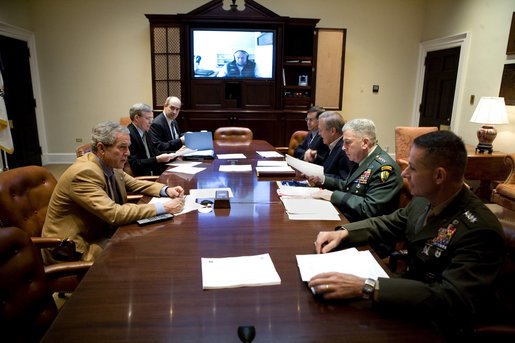
(caption) "President George W. Bush speaks during a video teleconference with Vice President Dick Cheney, on screen, and military commanders in the Roosevelt Room of the White House, Saturday, Oct. 21, 2006. Pictured from left are National Security Advisor Stephen Hadley, Deputy National Security Advisor J.D. Crouch, Senior Advisor to the Secretary of State on Iraq David Satterfield, Secretary of Defense Donald Rumsfeld, U.S. Army General John Abizaid and Chairman Joint Chiefs of Staff U.S. Marine General Peter Pace." [1]

"President Bush met with his top advisers and military commanders on Iraq yesterday in a White House session that, senior officials said, weighed options for forging a way forward amid the surging violence but did not contemplate any major shifts in strategy.
The participants in the 90-minute video conference -- who included Vice President Cheney, Defense Secretary Donald H. Rumsfeld, U.S. Ambassador to Iraq Zalmay Khalilzad and Gen. George W. Casey Jr., the military commander in Iraq -- talked about tactical changes that could overcome the severe challenges posed by the war, officials said.
"The participants focused on the nature of the enemy, the challenges in Iraq, how to better pursue our strategy, and the stakes of succeeding for the region and the security of the American people," said White House spokeswoman Nicole Guillemard.
The meeting, which the White House called the third in a series Bush has held with this group to consult on the war, did not consider any significant policy changes." [2]

Why wasn't Condoleezza Rice included in this meeting?

It seems that in a conflict where even the military says that there is no sole military solution, the Secretary of State should be at every important meeting to discuss and advocate possible diplomatic and governmental solutions.

In fact, the Department of State, not the Department of Defense, should have been the lead agency in Iraq soon after the fall of Saddam Hussein. That it was not may have been due, at least in part, to a vision of Iraq as an ally or instrument in the war on terror rather than as a vibrant, self-fulfilling nation in its own right.

And recall also that Rice was able to achieve a ceasefire in Lebanon after only 34 days, despite a late start.

sources
related postings
posted: monday, october 23, 2006, 5:59 AM ET
update: saturday, december 2, 2006, 5:25 AM ET

Labels: , , , , , , ,


View My Stats