Sunday, February 18, 2007

Sadr supports surge

"Iraqi President Jalal Talabani said anti-American Shiite cleric Moqtada al-Sadr has ordered his top deputies to leave Iraq in order to ease the implementation of the Baghdad security plan, which U.S. and Iraqi forces began to roll out this week.
. . . During a news conference Thursday night, Talabani said Sadr told government officials that he was 'eager for the stability of the state and the success of the security plan. He gave the government the green light to detain any outlaws.'
In Washington on Thursday, Defense Secretary Robert M. Gates said he believed that Sadr's followers were concerned about the new operation to secure Baghdad and suggested that Sadr and his militia would 'go to ground' over the coming months. 'And the question is, during that space . . . can we and the Iraqis provide enough security so that economic development, improvements in governance, political reconciliation can all begin to make real progress in Iraq?' Gates said."

source
Londono, Ernesto. (The Washington Post). Leader of Al-Qaeda in Iraq Injured in Clash, Official Says. February 16, 2007.

posted: sunday, february 18, 2007, 11:53 PM ET


tags:

Labels: , , ,

Friday, February 09, 2007

Possible redeployment if surge fails, Gates says

"Defense Secretary Robert M. Gates acknowledged Tuesday that Pentagon planners were considering alternative war plans in case the current buildup of forces in Iraq failed to quell ongoing violence in Baghdad.
Although he insisted the administration would give the new offensive the time and funding it needed, Gates told the Senate Armed Services Committee that if the strategy did not show the hoped-for results, the military would probably shift its efforts to a strategy centered on moving U.S. troops 'out of harm's way.'
. . . Despite Gates' vow to give the troop buildup the funding and support it needed, he reiterated his view that the increased manpower would be needed only for several months.
. . . The tepid endorsement by some in the Pentagon of the plan . . . has angered Republican advocates.
. . . 'If you're asking somebody in eight months to solve a 1,400-year-old religious dispute, bring people together who have suffered under a dictatorship for 30 years, reconstruct an economy that was raped by a dictator — that's a pretty tall order,' [Sen. Lindsey] Graham said."

source
Spiegel, Peter. (Los Angeles Times). Pentagon considering alternatives for Iraq. February 7, 2007.

posted: friday, february 9, 2007, 10:50 PM ET

update: tuesday, february 13, 2007, 7:45 PM ET

tags:

Labels: , , ,

Reconstruction part of surge lags; jobs & peace linked, study says

"Senior military officers . . . have told President Bush and Defense Secretary Robert M. Gates that the new Iraq strategy could fail unless more civilian agencies step forward quickly to carry out plans for reconstruction and political development.
. . . Mr. Gates said Tuesday that Ms. [Condoleezza] Rice had told him that her department needed six months to locate and prepare civil servants and contractors to send abroad.
. . . [F]rom the standpoint of personal security, taking those jobs — many of them, by definition, outside the relative safety of the Green Zone — is widely seen as an unattractive career option.
. . . Tasia Scolinos, a spokeswoman for the Justice Department . . . provided a fact sheet that showed that the Justice Department had 200 employees and contractors in Iraq as of last August." [1]

"The State Department has asked the Pentagon for 129 people to fill slots in 'business development, agribusiness, medicine, city management' and other areas for 10 new provincial reconstruction teams (PRTs), according to David Satterfield, [Condoleezza] Rice's coordinator for Iraq, who spoke to reporters in an afternoon briefing.
Deployments will last at least six months until Congress provides supplemental funding to pay for private contractors. The State Department has already filled its own slots on the new teams with 19 Foreign Service officers, Satterfield said, adding that the department is actively engaged in identifying appropriate contractors. The Agency for International Development will also supply personnel, he said.
. . . The administration has asked Congress for $538 million in supplemental funds to pay for the program. The PRTs, which are projected to be up and running by the end of next month, will be housed with U.S. military combat brigades." [2]

. . . [A] recent classified study, conducted by the Joint Warfare Analysis Center of the Defense Department . . . found that a 2 percent increase in job satisfaction among Iraqis in Baghdad correlated to a 30 percent decline in attacks on allied forces and a 17 percent decrease in civilian deaths from sectarian violence." [1]

source
[1] Shanker, Thom & Cloud, David S. (The New York Times). Military Wants More Civilians to Help in Iraq. February 7, 2007.
[2] DeYoung, Karen. (The Washington Post). Military Must Fill Iraq Civilian Jobs. February 8, 2007.


posted: friday, february 9, 2007, 10:06 PM ET

update: saturday, february 10, 2007, 11:37 PM ET

tags:

Labels: , , , , ,

Tuesday, January 23, 2007

Brits to exit Iraq's 2nd largest city without disarming militias, probably this spring

" 'As we see the need for less troops, the surplus will go home,' said Maj. Chris Ormond-King, a British military spokesman in Basra, where Mr. Gates held the talks with British commanders.
Major Ormond-King said that Britain maintains three bases inside Basra, Iraq’s second-largest city, but that plans were moving forward to turn over the city to full Iraqi control, a step that he added was 'probably achievable' by this spring.
He said that British commanders had no plans to disarm Shiite militia groups, including the Mahdi Army and the Badr Organization, that have been vying for power in the city, as long as they do not attack British forces. A critical part of the new American strategy for stabilizing Iraq is to persuade Mr. Maliki to disarm Shiite militias as well as Sunni insurgents.
. . . [U.S. Defense Secretary Robert] Gates said this week that Britain was making troop reductions at the same time Washington was building up forces in Iraq because conditions in southern Iraq are different than those in Baghdad and other parts of Iraq, where the United States has most of its troops."

source
The New York Times. General Sees Summer Deadline for Troops. January 20, 2007.

posted: tuesday, january 23, 2007, 2:46 PM ET

update: tuesday, january 23, 2007, 3:06 PM ET

tags:

Labels: , , , ,

Thursday, January 18, 2007

Gates open to Afghanistan troop increase

"Defense Secretary Robert M. Gates said Wednesday that American and NATO military commanders in Afghanistan, worried about a resurgent Taliban insurgency, had asked for additional troops and that he was sympathetic to the request.
Speaking to reporters after a two-day visit to Afghanistan . . . Mr. Gates said commanders had 'indicated what they could do with different force levels,' but he would not divulge the size of the increases under consideration. A senior Defense official said late Tuesday that the commanders were seeking fewer than 3,500 more American troops as well as about 1,000 more troops from NATO allies.
. . . The appeal follows the Bush administration’s announcement last week that it was sending more than 20,000 additional troops to Iraq, where the United States already has about 132,000 troops.
. . . 'There’s no reason to sit back and let the Taliban regroup,' Mr. Gates said. 'I think it’s very important that we not let this success in Afghanistan slip away from us.'

source
The New York Times. Gates Backs Generals’ Afghan Distress Call. January 18, 2007.

posted: thursday, january 18, 2007, 4:12 AM ET

tags:

Labels: , , ,

Saturday, January 06, 2007

National intelligence director to head State Dept's Iraq policy

"John D. Negroponte's departure as the nation's first director of national intelligence comes as the two-year-old office and the broad, post-Sept. 11 reorganization that created it have yet to reach the goal of uniting the intelligence community under a single leader.
But Negroponte's move to become Secretary of State Condoleezza Rice's deputy, and his replacement by retired Navy Adm. John M. McConnell, had little to do with any assessment of Negroponte's tenure or with the unfinished state of intelligence integration, a range of senior administration officials said.
Instead, it stemmed directly from the urgent need to fill a State Department job, vacant since early last summer, that was seen as crucial to implementing the new Iraq policy that President Bush plans to announce next week.
Negroponte will take charge of State's Iraq account as the administration begins a sharply uphill effort to turn around a failing war and persuade the new Democratic Congress to follow its lead. [He is] a career diplomat who served as Bush's ambassador at the United Nations and in Baghdad before becoming intelligence chief in April 2005." [1]

"Senior administration officials said that Ms. Rice wanted Mr. Negroponte to focus on China and North Korea, which have been among his focuses in the intelligence post, and on Iraq, a country he knows particularly well.
. . . Ms. Rice would continue to play a central role in Iraq policy, the official said, but she has also made it clear that she wants to devote more time to a broader diplomatic initiative aimed at Middle East peace.
. . . John E. McLaughlin, a former director of central intelligence who is a friend of Mr. Negroponte, said . . . he believed that Mr. Negroponte’s familiarity with the latest intelligence from Iraq would help to bring a 'realistic' view of the situation there as the administration works to develop a new strategy.
But other intelligence experts expressed concern about what Mr. Negroponte’s departure might mean to the office he helped to establish. “My major concern about this appointment is not about the State Department, but what happens at the D.N.I. office,” said Lee H. Hamilton, who served as co-chairman of both the 9/11 commission and the Iraq Study Group." [2]

So former CIA chief Robert Gates is the new Secretary of Defense and career diplomat turned national intelligence director Negroponte is about to lead the Department of State's Iraq agenda and help with President Bush's new plan for Iraq. Are military and intelligence the only two choices?

sources
[1] The Washington Post. Negroponte Moves to Job Considered Crucial at State Dept. January 5, 2007.
[2] The New York Times. Spy Chief’s Choice to Step Back Feeds Speculation. January 5, 2007.

posted: saturday, january 6, 2007, 5:09 AM ET

update: saturday, january 6, 2007, 5:49 AM ET

tags:

Labels: , , , , ,

Monday, November 13, 2006

Rice and Baker will probably work together on Iraq

"Over the past two months Secretary of State Condoleezza Rice and the national security adviser, Stephen J. Hadley, quietly steered the White House toward replacing Donald H. Rumsfeld with Mr. [Robert] Gates, who had worked closely with Ms. Rice under the first President Bush.
. . . Ms. Rice and Mr. Rumsfeld never managed to resolve their differences, especially after their arguments over the handling of the occupation came into public view in late summer 2003.
. . . Together with Ms. Rice, Mr. Gates is expected to have to put into action recommendations by the [James Baker] study group that are likely to call for initiatives involving European allies and Iraq’s neighbors in the Middle East. The new plans are expected to mix diplomacy, the training of Iraqi troops and the use of American force to quell the violence in Baghdad, and to require close coordination between the Departments of State and Defense."

source
The New York Times. In Gates Selection, White House Hopes to Close Rift Between State and Defense. November 12, 2006.

posted: monday, november 13, 2006, 2:37 AM ET

Labels: , , ,

Saturday, November 11, 2006

More American dialogue with Iran and Syria may be coming

"The Democratic takeover of Congress will raise the profile of lawmakers who have repeatedly urged the Bush administration to talk to key adversaries such as Iran, North Korea and Syria, increasing pressure on the White House to stop placing restrictions or conditions on such discussions.
. . . Iran and Syria are problematic neighbors of Iraq, and critics have charged that not talking to Damascus and Tehran has hurt efforts to end the violence in Iraq.
. . . Since Secretary of State Condoleezza Rice took office nearly two years ago, some restrictions on dealing with Iran and North Korea have been loosened.
. . . Outgoing Defense Secretary Donald H. Rumsfeld is a fierce foe of engaging with enemies, but [Robert] Gates two years ago co-wrote a Council on Foreign Relations report that called for a "direct dialogue" with Iran."

source
The Washington Post. Democrats May Urge More Contact With U.S. Adversaries. November 10, 2006.

posted: saturday, november 11, 2006, 3:25 PM ET
update: saturday, november 11, 2006, 3:27 PM ET

Labels: , , , , , ,

Monday, October 23, 2006

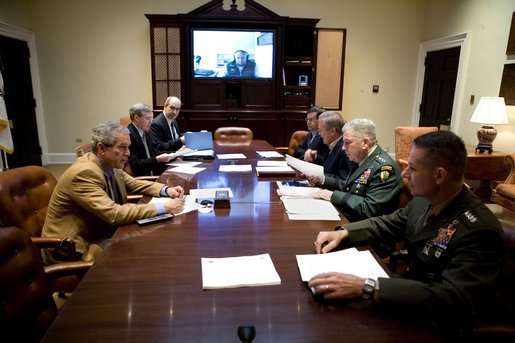
Why wasn't Condoleezza Rice at the recent White House meeting on Iraq?

(caption) "President George W. Bush speaks during a video teleconference with Vice President Dick Cheney, on screen, and military commanders in the Roosevelt Room of the White House, Saturday, Oct. 21, 2006. Pictured from left are National Security Advisor Stephen Hadley, Deputy National Security Advisor J.D. Crouch, Senior Advisor to the Secretary of State on Iraq David Satterfield, Secretary of Defense Donald Rumsfeld, U.S. Army General John Abizaid and Chairman Joint Chiefs of Staff U.S. Marine General Peter Pace." [1]

"President Bush met with his top advisers and military commanders on Iraq yesterday in a White House session that, senior officials said, weighed options for forging a way forward amid the surging violence but did not contemplate any major shifts in strategy.
The participants in the 90-minute video conference -- who included Vice President Cheney, Defense Secretary Donald H. Rumsfeld, U.S. Ambassador to Iraq Zalmay Khalilzad and Gen. George W. Casey Jr., the military commander in Iraq -- talked about tactical changes that could overcome the severe challenges posed by the war, officials said.
"The participants focused on the nature of the enemy, the challenges in Iraq, how to better pursue our strategy, and the stakes of succeeding for the region and the security of the American people," said White House spokeswoman Nicole Guillemard.
The meeting, which the White House called the third in a series Bush has held with this group to consult on the war, did not consider any significant policy changes." [2]

Why wasn't Condoleezza Rice included in this meeting?

It seems that in a conflict where even the military says that there is no sole military solution, the Secretary of State should be at every important meeting to discuss and advocate possible diplomatic and governmental solutions.

In fact, the Department of State, not the Department of Defense, should have been the lead agency in Iraq soon after the fall of Saddam Hussein. That it was not may have been due, at least in part, to a vision of Iraq as an ally or instrument in the war on terror rather than as a vibrant, self-fulfilling nation in its own right.

And recall also that Rice was able to achieve a ceasefire in Lebanon after only 34 days, despite a late start.

sources
related postings
posted: monday, october 23, 2006, 5:59 AM ET
update: saturday, december 2, 2006, 5:25 AM ET

Labels: , , , , , , ,


View My Stats